There are 6 major scale fretboard patterns for the guitar (when it’s tuned in standard tuning, EADGBE).
You’ll find all 6 moveable fretboard patterns below (2 patterns each include a variation), plus a diagram for the entire fretboard.
Use the Guitar Fretboard Note Table to figure out where to place any of the fretboard scale patterns/diagrams so they’ll be in the key of your chosing!
The roots (tonics) of the scales are in red.
In the diagrams, the numbers (1, 2, 3, 4) denote which finger to use to play that specific note.
Use the Guitar Fretboard Note Locator Table (located below the major scale fretboard diagrams). Please read the section How to Use the Fretboard Note Table to Find the Key of a Major Scale on the Fretboard Diagram to learn how to use the Guitar Fretboard Note Locator Table.
Table of Contents
Major Scale Diagrams – Root on 6th string
Major Scale, Form 1
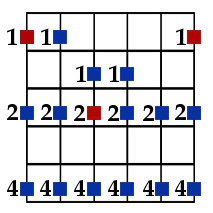
Major Scale, Form 2
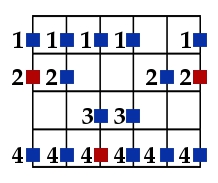
Major Scale, Form 3
This scale form has 2 variations. In the first, you stay in the same position. In the second variation, you shift up 2 frets.
Form 3, 1st Variation
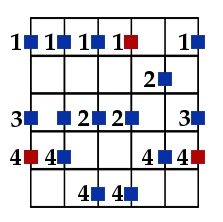
Form 3, 2nd variation
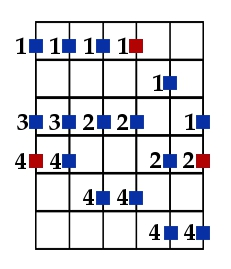
Major Scale Diagrams – Root on 5th string
Major Scale, Form 4
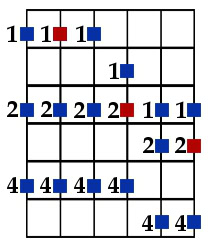
Major Scale, Form 5
Form 5, Variation 1
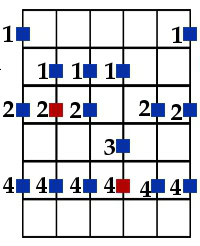
Form 5, 2nd variation
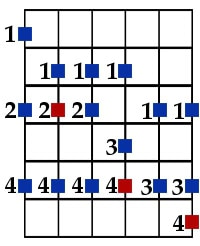
Major Scale, Form 6
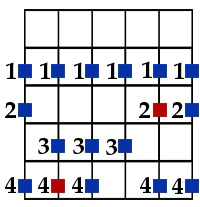
Moveable Guitar Fretboard – Full Fretboard – Major Scale

Guitar Fretboard Note Locator
How to Use the Fretboard Note Table to Find the Key of a Major Scale on the Fretboard Diagram
- What key for the major scale?
- For example, say you want to play in a G major scale.
- Look for the note G on the table below.
- You find 6th string, 3rd fret as one instance of G.
- Look above, to the moveable fretboard major scale diagram.
- Find a star (the “root” note of the major scale) on the 6th string.
- Now orient your scale patterns so that triangle is on the 6th string, 3rd fret of your guitar!
- Enjoy!
- Try singing/humming along to help get the notes/melodies of the scales in your ears.
- You can check your results for the G major scale against the diagrams located at G major scales (Fretboard diagrams, Standard and Tab Notation)
Guitar Fretboard Note Locator Table (up to the 15th fret)
| Fret # | E, 6th String | A, 5th String | D, 4th String | G, 3rd String | B, 2nd String | E, 1st String |
|---|---|---|---|---|---|---|
| 0 | E | A | D | G | B | E |
| 1 | F | A#/Bb | D#/Eb | G#/Ab | C | F |
| 2 | F#/Gb | B | E | A | C#/Db | F#/Gb |
| 3 | G | C | F | A#/Bb | D | G |
| 4 | G#/Ab | C#/Db | F#/Gb | B | D#/Eb | G#/Ab |
| 5 | A | D | G | C | E | A |
| 6 | A#/Bb | D#/Eb | G#/Ab | C#/Db | F | A#/Bb |
| 7 | B | E | A | D | F#/Gb | B |
| 8 | C | F | A#/Bb | D#/Eb | G | C |
| 9 | C#/Db | F#/Gb | B | E | G#/Ab | C#/Db |
| 10 | D | G | C | F | A | D |
| 11 | D#/Eb | G#/Ab | C#/Db | F#/Gb | A#/Bb | D#/Eb |
| 12 | E | A | D | G | B | E |
| 13 | F | A#/Bb | D#/Eb | G#/Ab | C | F |
| 14 | F#/Gb | B | E | A | C#/Db | F#/Gb |
| 15 | G | C | F | A#/Bb | D | G |
| Frets | E, 6th String | A, 5th String | D, 4th String | G, 3rd String | B, 2nd String | E, 1st String |
Understanding the Major Scale
| Scale tone | In C major | Interval | Chord | Mode | Mode Sounds like: |
| Root | C | 2 | Major 7th | Ionian | Happy |
| 2nd | D | 2 | Minor 7th | Dorian | Carlos Santana in Oye Como Va |
| 3rd | E | 1 | Minor 7th | Phrygian | Flamenco |
| 4th | F | 2 | Major 7th #11 | Lydian | Dreamy |
| 5th | G | 2 | Dominant 7th | Mixolydian | Blues, rock |
| 6th | A | 2 | Minor 7th | Aeolian | Minor |
| 7th | B | 1 | Half Diminished | Locrian | Leading somewhere |
| Octave | C | 2 | Major 7th | Ionian | Happy |
Scale Tones of a Major Scale
Major scales have 7 tones. They are:
- 1st – or root
- 2nd
- 3rd
- 4th
- 5th
- 6th
- 7th
After the the 7th tone, the 8th is the octave – is same note again – the 1st (or the root) of the major scale.
For example, the notes of a C Major Scale are:
![Shows the notes for the C major scale, ascending and descending. Tab is [6 string] x; [5th string] 3; [4th string] 0, 2, 3; [3rd string] 0, 2 [2nd string] 0, 1, 1, 0; [3rd string] 2, 0; [4th string] 3, 2, 0; [5th string] 3; [6 string] x;](https://sp-ao.shortpixel.ai/client/to_auto,q_glossy,ret_img,w_606,h_134/https://www.guitarkitchen.com/thoughts/thoughts/wp-content/uploads/2020/11/C-major-scale-with-TABAsset-1-1024x227.png)
Intervals of a Major Scale
12 notes (basically) compose almost all notes Western music.
I say almost because actually many musicians bend notes and add vibrato and other nuances. Also, the tuning of the notes of the scales used to done differently. Currently, most Western music uses Equal Temperament, so on a piano the intervals between all the notes are equal and all songs in different keys will sound (intervalicaly) the same.
But in written music, we only usually see 12 notes – the Chromatic Scale.
All the intervals are half-steps – in the table below the H=half step.
A half-step on the guitar is one fret. A whole-step is two frets.
| 1 | 2 | 3 | 4 | 5 | 6 | 7 | 8 | 9 | 10 | 11 | 12 | |
| with sharps | C | C# | D | D# | E | F | F# | G | G# | A | A# | B |
| with flats | C | Db | D | Eb | E | F | Gb | G | Ab | A | Bb | B |
| Interval | H | H | H | H | H | H | H | H | H | H | H | H |
So from the Chromatic Scale (12 notes), we can find all the notes of the major scale.
| 1 | 2 | 3 | 4 | 5 | 6 | 7 | 8 | |
| C major scale | C | D | E | F | G | A | B | C |
| Interval (W or H) | W | W | H | W | W | W | H | |
| Interval (with numbers) | 2 | 2 | 1 | 2 | 2 | 2 | 1 |
Chords (derived) from a Major Scale
Please check out Creating Diatonic Jazz Chords (and Melodies) from Major Scales and E Major Diatonic Scales, Intervals, Chords, Open Strings (Sheet Music & TAB) to learn more.
Diatonic means any note with a scale.
So basically, you use triads to create a chord – a triad means 3 notes. In general (with a 7-tone scale like the major scale), we use every other note from the scale to create the triad.
| Scale Tones | Triad Chord | Triad Note | Seventh chord | 7th chord notes |
| C | Major | C E G | Major 7th | C E G B |
| D | Minor | D F A | Minor 7th | D F A C |
| E | Minor | E G B | Minor 7th | E G B D |
| F | Major | F A C | Major 7th | F A C E |
| G | Major | G B D | Dominant 7th | G B D F |
| A | Minor | A C E | Minor 7th | A C E G |
| B | Diminished | B D F | Half diminished | B D F A |
| C | Major | C E G | Major 7th | C E G B |
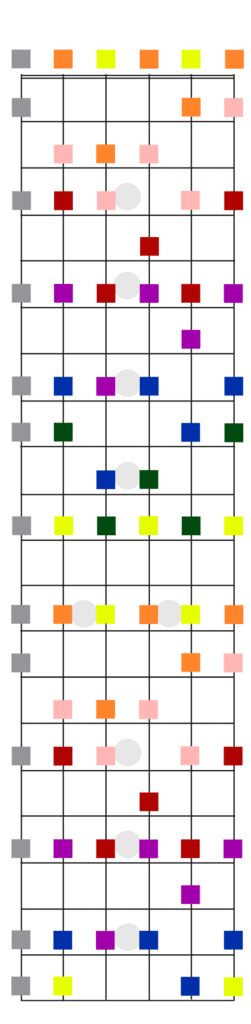
Special thanks to Jazz Guitar Licks for the the idea about showing the different diatonic scales with different colors!
Modes of a Major Scale
- Ionian
- Dorian
- Phrygian
- Lydian
- Mixolydian
- Aeolian
- Locrian
Using the notes of a major scale, each mode starts on a different note of the major scale. So Dorian starts on the 2nd, Phrygian the 3rd, etc.
| Note | Mode | Scale Notes | Intervals |
| C | Ionian | CDEFGABC | WWHWWWH |
| D | Dorian | DEFGABCD | WHWWWHW |
| E | Phyrgian | EFGABCDE | HWWWHWW |
| F | Lydian | FGABCEDF | WWWFWWH |
| G | Mixolydian | GABCDEFG | WWHWWHW |
| A | Aeolian | ABCDEFGA | WHWWHWW |
| B | Locrian | BCDEFGAB | HWWHWWW |
Sounds and Uses for the Modes of a Major Scale
Each mode has it’s own sound and can be incorporated into music in different ways. Here’s some examples
Ionian Mode – the major scale
The major scale is used in many different ways. It’s sort of self-referential.
Dorian Mode
The idea of the Dorian mode is usually used in the context of jazz. It has the quintessential minor 7th sound, like in So What by Miles Davis.
Phrygian Mode
The Phrygian mode sounds very different from the Dorian mode, even though both “create” a minor 7th chord. It usually is used to create Iberian or Spanish sound and is used in Flamenco. Even though diatonically the corresponding chord in a minor 7th, what sounds really good is a Dominant 7th chord – and you can add a b9.
So an E Phyrgian would sound great over an E major chord!
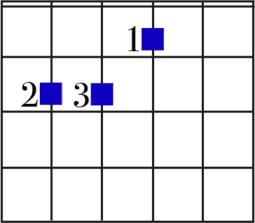
Or you could add a little more flavour:

Lydian Mode
The lydian mode also has a major 7th sound. But the #4 (or #11) makes it sound more dreamy or jazz. I usually associate French composers like Debussy with the Lydian sound (imho).
The lydian mode is used in jazz a lot especially instead of a “regular” major scale and the #4 is accentuated at the end of songs to give the song a more “harmonically” complex sound.
Mixolydian Mode
The mixolydian mode or scale is basically a major scale with a flatted 7th.
It works great over dominant 7 chords. It’s used in most music (whether consciously or subconsciously).
The mixolydian and dorian modes are great places to start hearing other scales over certain chords (dominant 7 and minor 7 chords, respectively).
Aeolian Mode
Think of the Aeolian mode or natural as a the pure minor mode. Dorian minor sounds “jazzy” and Phyrgian minor sounds “Spanish”.
The Aeolian mode is what we basically associate with a minor scale sound. It’s also the springboard to create lots of different minor scales, like the harmonic minor (Aeolian with a raised 7th) and melodic minor (Aeolian with raised 6th & 7th).
Locrian Mode
We’re not really used to hearing the Locrian mode by itself. It will usually be incorporated in music as part mode like the Ionian, Dorian or Mixolydian.
But it’s good for one’s ear to be able to hear it. The more popular version of the Locrian is the Super Locrian! The Super Locrian is a Locrian scale with a flatted 4.
Locrian would be BCDEFGAB. Super Locrian would be BCD(Eb/D#)FGAB.
The Super Locrian is also referred to as the Altered Scale because it is all the “altered” notes of a dominant 7th chord.
2 replies on “Major Scale Fretboard Diagrams for Guitar”
lots of good information here but I am stuck with covering the fret board using pentatonix
I love pentatonics too! For a lot of music, pentatonics will cover pretty much everything. If you want, you can add some extra notes in later … If you have any questions, please let me know!