
Table of Contents
What is the Melodic Minor Scale?
The melodic minor scale is a minor scale – it has a minor third, and a perfect fifth.
The melodic minor scale is the same as the major scale, but with a minor third.
Unlike the natural minor scale, the melodic minor scale contains a major 6th and a major 7th.
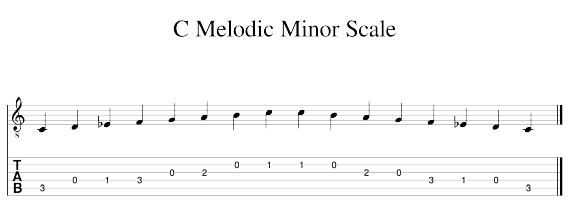
Please check below to learn about the difference between the pop/jazz melodic minor and the traditional/classical melodic minor.
| Scale Degree | 1 | 2 | 3 | 4 | 5 | 6 | 7 | 8 |
| C melodic minor | C | D | Eb | F | G | A | B | C |
| Numeric Interval | 1 | 2 | b3 | 4 | 5 | 6 | 7 | 8 |
- Major Scale Fretboard Diagrams for Guitar
- Pentatonic Scales (Fretboard Diagrams, Standard and Tab Notation)
The Classical/Traditional and the Jazz/Pop Melodic Minor

In the traditional C melodic minor, ascending scale is – Major 6th = A and the Major 7th = B. Descending it’s minor 7th = Bb and minor 6th = Ab.

In the pop/jazz C melodic minor, ascending and descending scales are – Major 6th = A and the Major 7th = B.
Traditionally the melodic minor scale ascends with a major 6th and a major 7th.
But it descends with a minor 7th and a minor 6th.
Traditionally, the descending melodic minor is the same as the natural minor scale.
This traditional style of melodic minor can be found in classical music.
In pop and jazz music, musicians play the melodic minor with the ascending portion of the melodic minor scale (M6, M7) for both the ascending and descending portions of the scale.
How Pop/Jazz, Traditional/Classical Melodic Minors and Natural Minor Scales Relate
| Ascending Melodic Minor | 1 | 2 | b3 | 4 | 5 | 6 | 7 | 8 |
| Descending Melodic Minor | 1 | 2 | b3 | 4 | 5 | b6 | b7 | 8 |
| Natural (Aeolian) Minor | 1 | 2 | b3 | 4 | 5 | b6 | b7 | 8 |
| C Ascending Melodic Minor | C | D | Eb | F | G | A | B | C |
| C Descending Melodic Minor | C | D | Eb | F | G | Ab | Bb | C |
| C Natural (Aeolian) Minor | C | D | Eb | F | G | Ab | Bb | C |
This article deals mostly with the pop/jazz version of the melodic minor scale.
This is the melodic minor scale built on just the ascending version of melodic minor.
If you’re interested in checking out some beautiful baroque music using the traditional melodic minor scale:
- D minor Gigue, Partita II, JS Bach, Solo Violin BMV 1004
- B minor Double (Sarabande), Violin Partita #1 (BMV 1002)
Two Easy Ways to Create Melodic Minor Scales
How to Create a Melodic Minor Scale from a Major Scale
Take a major scale and change the major third to a minor third.
| Major Scale | 1 | 2 | 3 | 4 | 5 | 6 | 7 | 8 |
| Melodic Minor | 1 | 2 | b3 | 4 | 5 | 6 | 7 | 8 |
| C major scale | C | D | E | F | G | A | B | C |
| C melodic minor | C | D | Eb | F | G | A | B | C |
Major Scale Fretboard Diagrams for Guitar
How to Create a Melodic Minor Scale from a Natural Minor Scale
Take a natural minor scale and raise the 6th and 7th degrees.
| Natural Minor Scale | 1 | 2 | b3 | 4 | 5 | b6 | b7 | 8 |
| Melodic Minor | 1 | 2 | b3 | 4 | 5 | 6 | 7 | 8 |
| C natural minor scale | C | D | Eb | F | G | Ab | Bb | C |
| C melodic minor | C | D | Eb | F | G | A | B | C |
Musicality Tip for Scales
This has helped me a lot – I believe it could help you, too!
If the scale you are practicing is in your vocal range (fairly comfortable to hum/sing), try singing the scale as you practice it.
You don’t have to sing all the time, but try it sometimes – it can really improve your memory, ear and learning!
- Singing – What You May Learn as a Guitarist!
- Play what you sing, sing what you play!
- Learning Songs: Listen, Sing, Play
- Playing what they’re singing
Guitar Fretboard Melodic Minor Scale Patterns
Full Moveable Melodic Minor Scale Fretboard Diagram
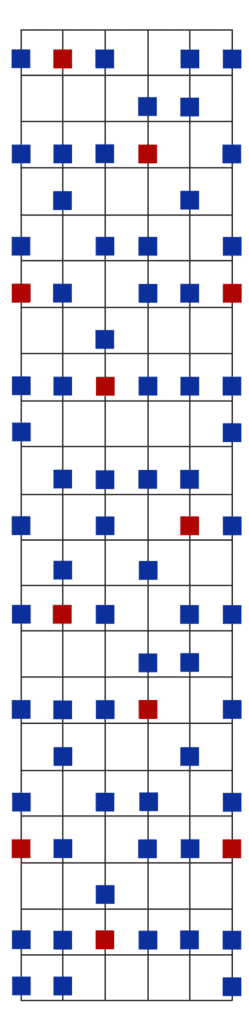
Melodic Minor Scale Shapes – Fretboard Diagrams
Melodic Minor Fretboard Shapes – 6th String Root
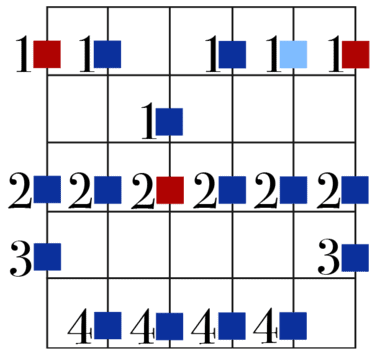

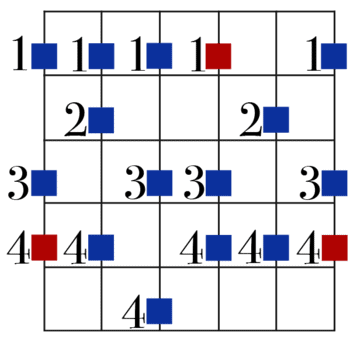
Melodic Minor Fretboard Shapes – 5th String Root
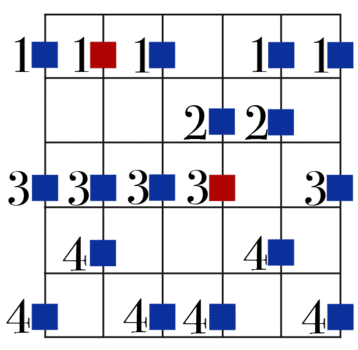


Guitar Fretboard Note Locator
How to Use the Fretboard Note Table to Find the Key of a Melodic Minor Scale on the Fretboard Diagram
- Determine what key for the melodic minor scale.
- For example, say you want to play in a G melodic minor scale.
- Look for the note G on the table below.
- You find 6th string, 3rd fret as one instance of G.
- Look above, to the moveable fretboard melodic minor scale diagram.
- Find a red note (the “root” note of the melodic minor scale) on the 6th string.
- Now orient your scale patterns so that triangle is on the 6th string, 3rd fret of your guitar!
- Enjoy!
- Try singing/humming along to help get the notes/melodies of the scales in your ears.
Guitar Fretboard Note Locator Table (up to the 15th fret)
| Fret # | E, 6th String | A, 5th String | D, 4th String | G, 3rd String | B, 2nd String | E, 1st String |
|---|---|---|---|---|---|---|
| 0 | E | A | D | G | B | E |
| 1 | F | A#/Bb | D#/Eb | G#/Ab | C | F |
| 2 | F#/Gb | B | E | A | C#/Db | F#/Gb |
| 3 | G | C | F | A#/Bb | D | G |
| 4 | G#/Ab | C#/Db | F#/Gb | B | D#/Eb | G#/Ab |
| 5 | A | D | G | C | E | A |
| 6 | A#/Bb | D#/Eb | G#/Ab | C#/Db | F | A#/Bb |
| 7 | B | E | A | D | F#/Gb | B |
| 8 | C | F | A#/Bb | D#/Eb | G | C |
| 9 | C#/Db | F#/Gb | B | E | G#/Ab | C#/Db |
| 10 | D | G | C | F | A | D |
| 11 | D#/Eb | G#/Ab | C#/Db | F#/Gb | A#/Bb | D#/Eb |
| 12 | E | A | D | G | B | E |
| 13 | F | A#/Bb | D#/Eb | G#/Ab | C | F |
| 14 | F#/Gb | B | E | A | C#/Db | F#/Gb |
| 15 | G | C | F | A#/Bb | D | G |
| Frets | E, 6th String | A, 5th String | D, 4th String | G, 3rd String | B, 2nd String | E, 1st String |
Melodic Minor and Jazz Guitar

Every style of music is beautiful – but melodic minor holds a special place in a lot of jazz musicians hearts!
Two Main Reasons why Jazz Loves Melodic Minor
- The altered scale aka the super locrian scale aka the 7th mode of melodic minor.
- Because jazz musicians love to play a major 6th note over minor chords! Melodic minor and Dorian minor are the 2 main scales in jazz that contain the major 6th. Natural minor and harmonic minor have minor 6ths (b6, flatted 6th)
Super Locrian aka the Altered Scale
The mode from the 7th degree of the melodic minor is called super-locrian! You may recall that the mode based on the 7th degree of the major scale is called locrian.
| Melodic Minor | 1 | 2 | b3 | 4 | 5 | 6 | 7 | 8 | |
| Super Locrian | 7 | 1 | 2 | b3 | 4 | 5 | 6 | 7 | |
| C Melodic Minor | C | D | Eb | F | G | A | B | C | |
| B Super Locrian | B | C | D | Eb | F | G | A | B |
The Super-Locrian Mode is the Altered Scale!
Jazz musicians love playing altered notes. This is why jazz musicians love melodic minor – because they play the altered scale and therefore the melodic minor.
There’s many altered notes – but the altered scale aka super locrian contains basically all of them:
- b9
- #9
- #4/b5 – the blue note
- b6/b13
- b7/#13
| Super Locrian | 1 | b2 | b3 | b4 | b5 | b6 | b7 | 8 |
| B Super Locrian | B | C | D | Eb | F | G | A | B |
| Altered notes of a super locrian | 1 | b9 | #9 | M3 | #4/b5 | b6/b13 | b7/#13 | 8 |
The super locrian scale contains a b9, #9, major 3rd, #4/b5 aka tritone aka blue note, b6 aka b13, b7 aka #13.
How Super Locrian and Locrian Relate
Remember that the melodic minor scale and the major scale share almost all the same scale tones – except for the the third scale tone. Melodic minor has a minor third and the major scale has a major third.
| Major Scale | 1 | 2 | 3 | 4 | 5 | 6 | 7 | 8 |
| Melodic Minor | 1 | 2 | b3 | 4 | 5 | 6 | 7 | 8 |
| C major scale | C | D | E | F | G | A | B | C |
| C melodic minor | C | D | Eb | F | G | A | B | C |
So, in similar fashion, the locrian and super-locrian modes share all the same notes, except for one – the 6th. The locrian has a Major 6th, and the Super-Locrian has a minor 6th.
| Locrian | 1 | b2 | b3 | 4 | b5 | b6 | b7 | 8 |
| Super Locrian | 1 | b2 | b3 | M3/b4 | b5 | b6 | b7 | 8 |
| B Locrian | B | C | D | E | F | G | A | B |
| B Super Locrian | B | C | D | Eb | F | G | A | B |
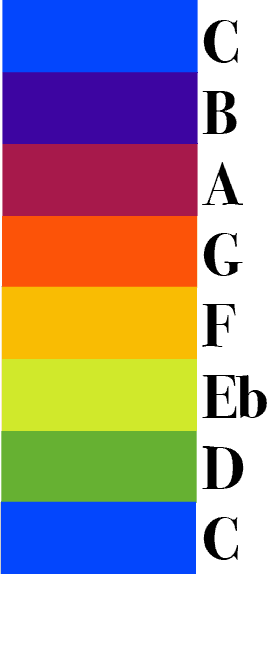
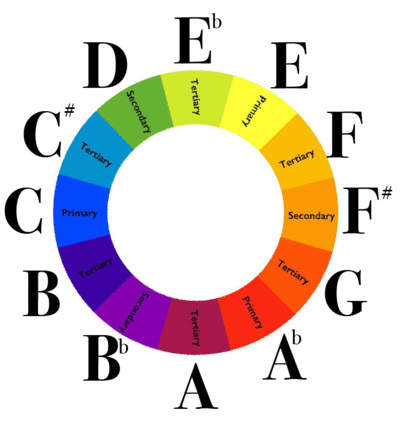
Color Visualization of a C Melodic Minor Scale
This isn’t based on a scientific relationship between the wave lengths of different color and tones.
It’s rather a color visualization, somewhat arbitrarily based on the painter’s color wheel.
Just for music theory fun!
I do hope to create a color visualization that’s more accurate, in terms of actually numbers that may correspond between sound and light. Here’s what I have so far.
Here’s the corresponding color wheel I used to create the visualization of the above C melodic minor scale!
The Melodic Minor – 6/8 Clave Connection!
This is pretty cool! It doesn’t necessarily have any deeper meaning (though it may!) – but it’s a cool and fun way to relate scales to rhythm and clave!
The traditional/classical melodic minor is almost the same as the 6/8 clave!
There’s more than one 6/8 clave – but I’m just using one type here.
What is a 6/8 Clave?
The 6/8 clave is believed to originate from traditional West African music.
There are different 6/8 claves, but this is a common 6/8 clave.

In Cuba and other places in the Caribbean and the Americas, these 6/8 claves became adapted to music in 4/4, so a lot of the music in 4 uses a modified version of the 6/8 clave.
Some examples – the Brasilian Bossa Nova Clave. And the Son Clave and the Rumba Clave. The Son Clave and the Rumba Clave are used in many musical styles, the most popular “genre” is commonly referred to as salsa.

How the 6/8 Clave and a 4/4 Clave relate!
For exampe, can you kind of see how the 6/8 Clave sort of looks the same as the 3-2 Son Clave?
- How to Play Salsa Guitar!
- Playing Tumbao and Montunos Together, Fingerstyle Salsa Guitar Studies/Lessons
Converting a Scale to a Rhythmic Phrase
- There 12 half-steps in a Western scales
- Therefore intervals of any Western scale add up to 12 half-steps
- For each interval (usually a half-step or whole-step) we can (for fun!) correspond it to a rhythm.
- A half-step is an eighth-note (1/8)
- A whole-step is a quarter note (2/8 = 1/4)
- Since there are 12 eighth-notes in a converted scale, we can express this as 2 bars of 6/8 or 1 bar of 12/8.
- Then we just write out the rhythm of the converted scale and see what is sounds like!
Converting Melodic Minor Scales to 12/8 Rhythms
| Ascending Melodic Minor | 1 | 2 | b3 | 4 | 5 | 6 | 7 | 8 |
| Descending Melodic Minor | 1 | 2 | b3 | 4 | 5 | b6 | b7 | 8 |
| C Ascending Melodic Minor | C | D | Eb | F | G | A | B | C |
| C Descending Melodic Minor | C | D | Eb | F | G | Ab | Bb | C |
| C Ascending Melodic Minor – Intervals | W | H | W | W | W | W | H | |
| Number of half-steps (Ascending) | 2 | 1 | 2 | 2 | 2 | 2 | 1 | |
| Corresponding Rhythm in 6/8 (ascending) | 2/8 | 1/8 | 2/8 | 2/8 | 2/8 | 2/8 | 1/8 | |
| C Descending Melodic Minor – Intervals | W | H | W | W | H | W | W | |
| Number of half-steps (Descending) | 2 | 1 | 2 | 2 | 1 | 2 | 2 | |
| Corresponding Rhythm in 6/8 (descending) | 2/8 | 1/8 | 2/8 | 2/8 | 1/8 | 2/8 | 2/8 |

The rhythm is very much like a 6/8 clave!
Line 1 shows the scale. Line 2 shows the conversion of the scale to rhythm. Line 3 shows a 6/8 clave.

The rhythm is almost the same as a 6/8 clave!
Line 1 shows the scale. Line 2 shows the conversion of the scale to rhythm. Line 3 shows a 6/8 clave.
Practice Makes Progress!

Best wishes to everyone!